The Real Reason Nonprofit Leaders Struggle to Show Funder-Ready Impact
Most nonprofit leaders don't struggle to deliver good work. They struggle to prove it.
You're likely already doing the heavy lifting. Your staff is conducting intakes, providing services, and connecting clients with resources. The impact is real. It's visible in the community. Yet, when grant reports are due, the narrative often feels fragmented.
The gap between what you do and what you can report is usually caused by a lack of connected data.
When client information lives in silos - spreadsheets, paper files, email chains, and disjointed software - turning daily casework into a cohesive impact story becomes a manual, error-prone chore. This article explores why this disconnect happens and how to build a clearer path from intake to impact without adding more burden to your team.
The Fragmentation Trap
Nonprofits often accumulate tools over time. A CRM for donors. A separate tool for case management. Spreadsheets for tracking specific program outcomes. Email for communication.
While each tool serves a purpose, the lack of integration creates a "fragmentation trap."
- Data Entry Duplication: Staff must enter the same client information multiple times into different systems. This increases administrative time and the risk of human error.
- Incomplete Client Stories: A caseworker might see a client's housing status in one system but their employment training progress in another. Leadership sees isolated data points, not the holistic journey.
- Reporting Lag: Compiling data from five different sources takes days or weeks. By the time the report is ready, the insights are stale, and the team is worn out.
This fragmentation is the primary reason many organizations struggle to produce timely, accurate, and compelling funder-ready reports. Modern funders don't just want to know that you helped people; they want to see the trajectory, the consistency, and the tangible outcomes. Fragmented data makes that trajectory nearly impossible to visualize clearly.
Why Manual Reporting Fails at Scale
Early in an organization's life, manual reporting might work. A small team can manage data in a single Excel file. But as programs grow, so does the volume of client interactions.
Manual processes don't scale. They break.
When reporting relies on manual aggregation, several issues emerge:
- Inconsistent Metrics: Different staff members may define or record metrics differently. One caseworker might log a "service" as a phone call, while another logs it as an in-person meeting. This inconsistency skews data accuracy.
- Missed Deadlines: The end-of-quarter rush leads to overtime, burnout, and rushed submissions. Quality suffers when speed is prioritized over accuracy.
- Lost Context: Numbers tell part of the story, but context tells the whole story. Without linked notes, documents, and service histories attached directly to client records, reports lack the nuance that funders look for.
The goal isn't to eliminate reporting but to make it a natural byproduct of good case management, not a separate, dreaded task.
Building a Single Source of Truth
The solution lies in centralizing client data. A single source of truth ensures that every interaction, note, and service outcome is recorded in one place.
This doesn't mean using one giant, complex system that staff resist. It means using a tool designed for the reality of nonprofit work. The system should be intuitive enough that staff adopt it quickly, reducing training time and resistance.
Key elements of a centralized approach include:
- Unified Client Profiles: Every client has one record that houses their intake details, service history, assessments, and documents.
- Standardized Service Tracking: Services are logged consistently, allowing for accurate aggregation of outcomes.
- Linked Documentation: Notes and files are attached directly to the client record, providing context for every data point.
When data is centralized, reporting shifts from a data-gathering exercise to a data-retrieval exercise. You're not creating the story; you're revealing the story that is already being recorded.
From Daily Casework to Automated Insights
The most effective nonprofit systems bridge the gap between daily operations and strategic reporting. This is achieved through design that prioritizes simplicity and automation.
Consider the workflow of a caseworker. They meet with a client, provide a service, and update the record. If the system is cumbersome, the "updating the record" step is delayed or skipped. If the system is streamlined, the update happens in seconds.
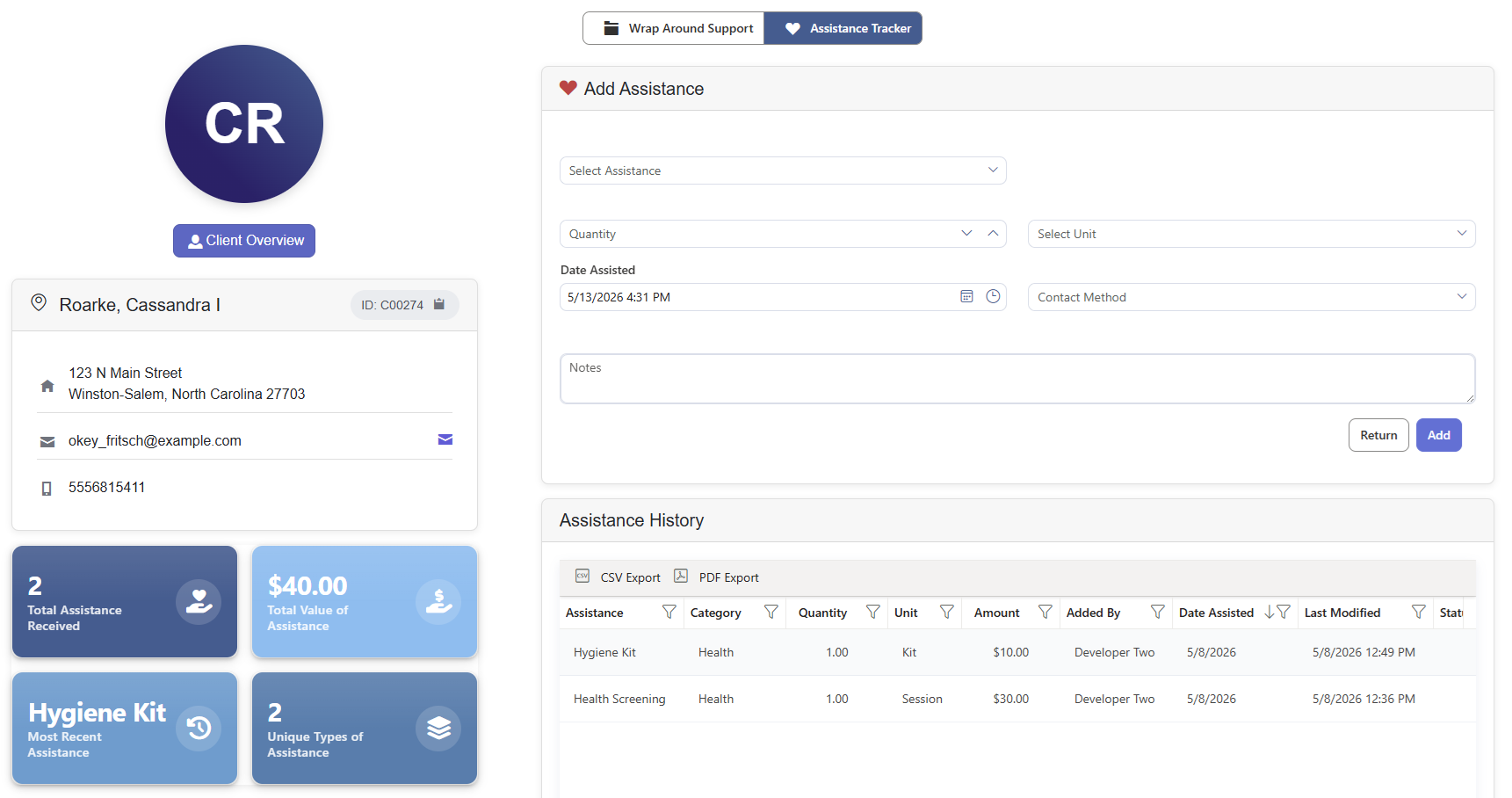
A well-designed workflow, like the Add Assistance workflow shown above, provides immediate visibility into key metrics for each client and makes it simple to record services. This means that as caseworkers do their job, they're also building the data foundation for reporting.
But visibility is only half the battle. The other half is automation.
Automations handle the repetitive tasks that drain staff time. For example:
- Auto-Enrollments: New clients can be automatically added to relevant programs based on their intake responses.
- Triggered Communications: Follow-up emails or SMS messages can be sent automatically after a service is logged.
- Status Updates: Client milestones can be tracked and updated without manual intervention.
These automations reduce busywork, ensuring that staff spend more time with clients and less time on administrative tasks. They also ensure that data is captured consistently, which is critical for accurate reporting.
Visualizing Impact for Funders
Funders need to see impact clearly. They look for trends, outcomes, and efficiency. A system that supports robust reporting capabilities allows nonprofits to present their case confidently.
Custom reports and dashboards enable organizations to slice and dice data in ways that highlight their specific strengths. Whether it's tracking housing stability, employment outcomes, or food security, the data should be accessible and visualizable.
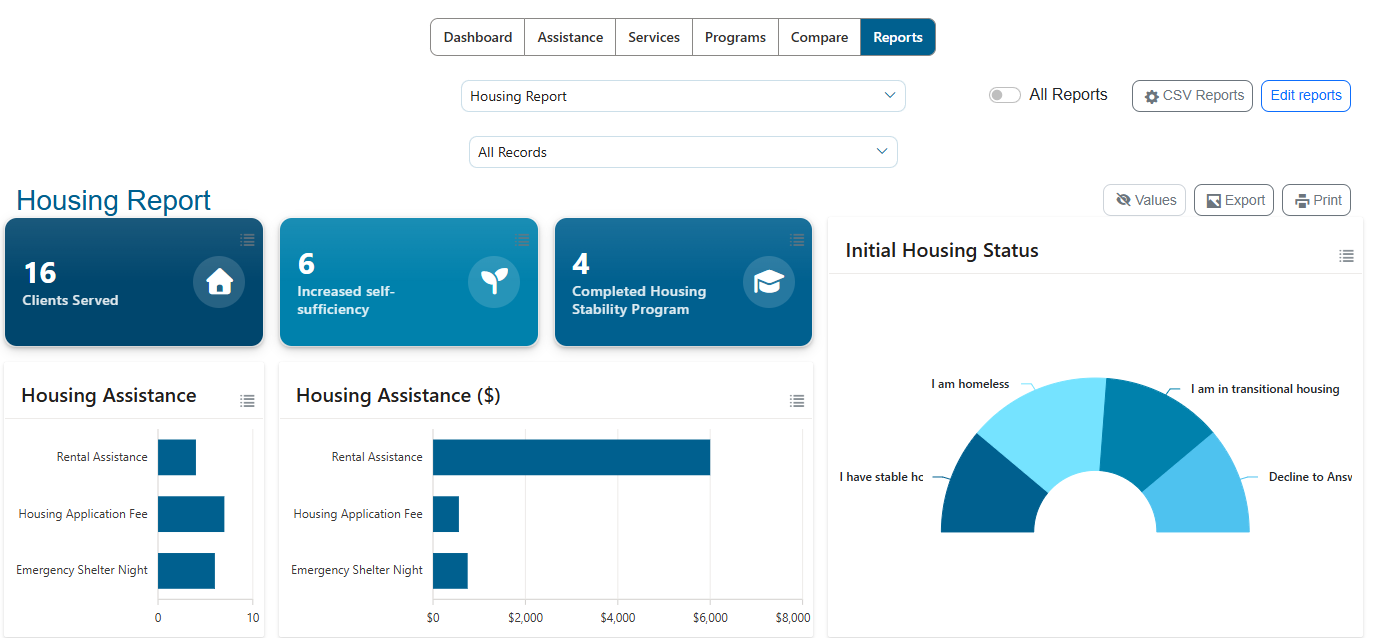
For instance, a Housing Report can visualize client outcomes through clear charts and summary cards. It can show how many clients served, how many improved their housing situation, and the breakdown of assistance types. This level of detail transforms raw data into a compelling narrative of change.
The key is that these reports are generated from the same data used for daily casework. There is no need to reconcile different datasets. The report reflects reality as it is being recorded.
The Role of Intuitive Design
Technology should serve the mission, not complicate it. If a case management system is difficult to use, staff will find workarounds. They might revert to spreadsheets or paper they stow away on the side, undermining the very purpose of the software.
Intuitive design is critical for adoption. This means:
- Clean Interfaces: A clutter-free layout that focuses on essential tasks.
- Mobile Accessibility: Staff often work in the field. Mobile access allows them to update records on the go.
- Quick Workflows: Logging a service or updating a status should take seconds, not minutes.
When staff find the tool helpful and easy to use, data quality improves. When data quality improves, reporting becomes reliable. And when reporting is reliable, confidence in demonstrating impact grows.
Aligning Operations with Outcomes
Ultimately, the goal is to align daily operations with strategic outcomes. This alignment ensures that every action taken by staff contributes to the broader mission and can be measured effectively.
By centralizing data, automating routine tasks, and using intuitive design, nonprofits can create a seamless flow from intake to impact. This flow reduces administrative burden, improves data accuracy, and enhances the ability to communicate value to funders.
It's cliche, but true: the struggle to show funder-ready impact is not about working harder. It's about working smarter. It's about building systems that capture the story of change as it happens, so that reporting becomes a reflection of your success, not a scramble to prove it.
Next Steps
If your team is tired of chasing data and spending weekends compiling reports, it may be time to evaluate your current case management approach. A platform designed for simplicity and impact can help you reclaim time and build confidence in your reporting.
Cohoist offers a refreshingly simple way to connect intake, service tracking, and reporting in one clean system. By focusing on workflow-first design and automation, it helps nonprofits move from fragmented data to funder-ready impact with less effort. To see how it can work for your organization, consider scheduling a demo.
Ready to put this into practice?
Cohoist gives your team clean intake, fast service tracking, and funder-ready reports — without the clutter of traditional systems. See how simple it can be.